You said something slightly awkward in a meeting on Tuesday. It’s now Thursday night, and you’ve replayed it maybe forty times. Each replay adds a new detail: the pause after you spoke, the look someone gave you, what they probably think of you now. Nothing new has happened. Your brain just keeps pressing play.
That loop has a name, and there is real research on how to get out of it. Writing can help, but only some kinds of writing. Writing that asks the wrong questions can keep you going around in circles. This article covers what the studies found, a 15-minute routine you can try tonight, and 15 journal prompts for overthinking, sorted by the kind of loop you’re stuck in.
Overthinking is usually one of two loops
Psychologists split most overthinking into two related habits. Rumination looks backward: replaying what happened, what you said, what it meant, why you’re like this. Worry looks forward: negative, hard-to-control thinking about things that haven’t happened yet and might not.
The two travel together. A 2023 meta-analysis by Elizabeth Stade and Ayelet Meron Ruscio, pooling 233 studies and more than 69,000 participants, found they are strongly linked but not the same thing. That matters for journaling, because the prompts that loosen one loop are a little different from the prompts that loosen the other. Before you write, it helps to ask: am I stuck in the past, or spinning about the future?
What the research says about writing it down
Writing about feelings and brooding. In a 2006 study in Behavior Therapy, Eva-Maria Gortner, Stephanie Rude and James Pennebaker asked college students who had been depressed in the past to write for three days, either about their emotions or about a neutral topic. Among students who tended to bottle up their feelings, the emotional writing group had fewer depressive symptoms six months later. The improvement seemed to come through less brooding, the gloomy, self-critical kind of rumination. The benefit showed up only in that bottling-up group, not in everyone.
A 2008 study by Sloan and colleagues pointed the same way: people who brooded more seemed to get more out of expressive writing. But the picture isn’t simple. In a 2013 University of Arizona study of 90 recently separated adults, the people who ruminated the most were doing best eight months later if they had written plain accounts of their days instead of digging into their feelings. So for some overthinkers, more emotional digging isn’t automatically better. Structure seems to matter as much as feelings.
Asking “how” instead of “why.” Edward Watkins, a psychologist who studies rumination, has found that people stuck in depressive rumination tend to think about their problems in vague, abstract terms: why did this happen, what does it say about me. In a 2009 study, his team trained people with depression to think concretely instead: what exactly happened, step by step, and what’s the next step. After a week of daily practice, their depression symptoms dropped more than in a comparison group. “Why” questions tend to keep the loop spinning. “How” questions tend to point toward the exit.
Stepping back. Psychologist Ethan Kross at the University of Michigan studies what he calls self-distancing: looking at a painful moment as if you were a fly on the wall, or thinking about yourself in the third person. In one of his studies, people who reflected on an upsetting experience this way reported less anger and fewer aggressive thoughts, and got less caught up in replaying the emotional details.
Giving worry a time slot. In a small 2012 study at the University of Illinois Chicago, 46 people spent two weeks either holding a daily 30-minute “worry period” at a set time and place, or simply trying to accept their worries. The worry-period group ended up with less worry, anxiety and insomnia. The NHS teaches a shorter version: about 10 to 15 minutes of worry time once a day.
The honest summary: these are mostly small studies, many with college students, and none of them prove that a journal will fix overthinking. But they agree on a pattern. Writing helps most when it moves you from vague to specific, from inside the loop to a step outside it, and from endless to time-limited. Writing that just repeats the loop on paper usually doesn’t help. We cover where that line sits in Does Journaling About Anxiety Help, or Make It Worse?
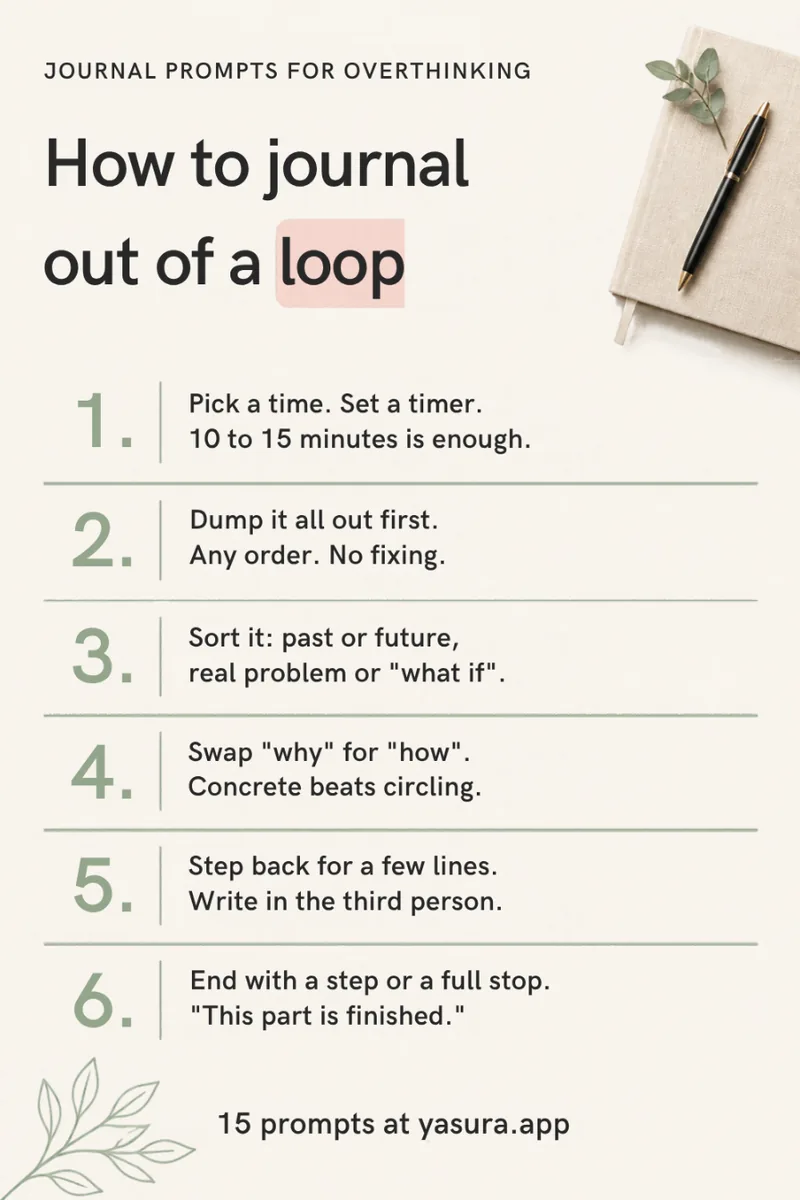
A 15-minute way to write your way out of a loop
Pick a time, and set a timer
Give it 10 to 15 minutes, ideally at the same time each day. If it’s keeping you up at night, try the early evening instead of right before bed. When a thought shows up at another time, tell yourself it has a slot later.
Dump it all out first
Spend the first few minutes writing everything that’s spinning, in any order. Don’t fix the grammar. The goal is to get it out of your head and onto the page.
Sort it: past or future, problem or “what if”
Next to each item, mark whether you’re replaying the past or worrying about the future. Then mark whether it’s a practical problem you can act on, or a “what if” you can’t.
Swap “why” for “how”
Pick one item. Instead of “why did I say that?”, write how it actually unfolded, step by step, and what you could do next. Concrete beats clever.
Step back for a few lines
Write the next part about yourself in the third person, using your own name. “Maya is upset because…” It feels odd for about two sentences, then it often feels calmer.
End with a step or a full stop
Finish with one small next step, or, if there’s nothing left to do, a line like “This part is finished.” Then close the journal and do something else for a while.
15 journal prompts for overthinking
Pick the group that matches your loop, and answer one or two prompts, not all fifteen.
When you can’t stop replaying something
- Write the moment you keep replaying as if you were a camera in the corner of the room. Who said what, in what order? Facts only.
- What story is my mind telling about what it means? Now write one other explanation that fits the same facts.
- Instead of “why did this happen?”, answer: how did it unfold, step by step?
- If a friend told me this exact story, what would I say to them?
- Is there anything left to do about this? If yes, write the next step. If no, write: “This part is finished.”
When you’re spinning about what might happen
- What exactly am I worried will happen? Say it in one sentence.
- Is this a problem I can act on, or a “what if” I can’t control right now?
- If it does happen, what would I realistically do in the first hour?
- What do I actually know right now, and what am I guessing?
- What’s one small thing I can do about this in the next 24 hours?
When you’re stuck on a decision
- Write the decision as a single question. If it takes more than one sentence, it might be two decisions.
- If I had to choose in the next ten minutes, what would I pick? What does that tell me?
- Which option would I regret not trying a year from now?
- What information would actually change my mind, and can I get it this week?
- Write a few lines in the third person: “[Your name] keeps going back and forth because…”
If you notice the same thoughts coming out in the same words after ten minutes, that’s your cue to stop, not to write harder. Close the page and come back at your next slot. For the nights when overthinking turns into lying awake, try the prompts in 12 Journal Prompts for When You Can’t Sleep.
Everyone overthinks sometimes. But if the loops are there most days for weeks, keep you from sleeping, working or enjoying things, or come with unwanted thoughts you can’t shake, it’s worth talking to a doctor or a therapist. Repetitive thinking is part of anxiety and depression, and approaches like cognitive behavioral therapy have specific tools for it. If your thoughts turn to hurting yourself, in the US you can call or text 988 to reach the 988 Suicide & Crisis Lifeline, any time. If you’re in immediate danger, call 911. A journal is not a substitute for professional help.
Where Yasura fits
I build Yasura, a journal app, so read this part with that in mind. Overthinking writing is often the most unfiltered writing you do: the embarrassing replay, the worst-case version, the thing you’d never say out loud. It’s easier to write honestly when you know nobody else will read it. Yasura works 100% offline, with no account and no cloud, and your journal is encrypted on your device. You can lock it with its own PIN plus Face ID or fingerprint, and Decoy Mode keeps your entries protected if someone else picks up your phone. You pay once, with no subscription and no ads.
But honestly, a notebook and a pen work just as well for this. The research is about the way you write, not the tool you write in.
Sources: Stade & Ruscio, “A Meta-Analysis of the Relationship Between Worry and Rumination,” Clinical Psychological Science (2023); Gortner, Rude & Pennebaker, “Benefits of expressive writing in lowering rumination and depressive symptoms,” Behavior Therapy (2006); Yang & Li, “Training Positive Rumination in Expressive Writing…,” Frontiers in Psychology (2020), reviewing Sloan et al. (2008); University of Arizona News on Sbarra et al. (2013); Cognition and Psychopathology Lab, Toronto Metropolitan University, “Why vs. How: The Role of Abstract and Concrete Thinking in Anxiety and Depression” (2020), on Watkins (2007) and Watkins, Baeyens & Read (2009); University of Michigan LSA, “From a Safe Distance” (2012), on Ethan Kross’s self-distancing research; McGowan, “The Efficacy of Stimulus Control for Worry,” University of Illinois Chicago (2012); NHS Every Mind Matters, “Tackling your worries”; 988 Suicide & Crisis Lifeline.
Try Yasura
A private place for the replays, the what-ifs and the decisions you keep circling. Works 100% offline, no account, no cloud, encrypted on your device and locked with your PIN or biometrics. One-time purchase unlocks Decoy Mode and the rest of the premium features.