It’s 2:40 a.m. Your body is tired, but your brain has opened every tab at once: the email you didn’t answer, the thing you said at dinner, the appointment on Thursday, a conversation from three years ago. You turn over. You check the time. Now it’s 2:52.
Writing things down is one of the most common pieces of advice for nights like this, and there is some real research behind it. There is also less than the internet suggests. This article walks through what the studies actually found, when writing seems to help most, and 12 prompts for the different kinds of sleepless night.
Why your mind gets loud when the room gets quiet
During the day, your attention is busy. At night, the noise drops away and whatever was waiting in the background moves to the front. A lot of that is unfinished business: tasks, worries, and conversations that haven’t been closed yet.
Sleep researchers have a simple explanation for why this is so stubborn. Michael Scullin, who runs a sleep lab at Baylor University, put it plainly: “Most people just cycle through their to-do lists in their heads.” The idea is that unfinished things stay mentally active, so your brain keeps returning to them in case you forget. That’s the researchers’ explanation, not a proven mechanism, but it matches how a sleepless night feels from the inside.
What the research actually says about writing before bed
The to-do list study. In a 2018 study in the Journal of Experimental Psychology: General, Scullin and colleagues had 57 healthy young adults spend a night in a sleep lab. Before lights out, half spent five minutes writing a to-do list for the coming days. The other half wrote about tasks they had already finished. The to-do group fell asleep about nine minutes faster on average, roughly 16 minutes compared with 25, measured with lab equipment rather than self-report. The more specific the list, the faster people tended to fall asleep.
Before you treat that as settled, notice the limits. It was one night. The participants were students without insomnia. Other sleep measures didn’t change significantly. The researchers themselves said a bigger study is needed.
The worry-and-solution study. In a 2003 study at Louisiana State University, Colleen Carney, then a psychology graduate student and now a sleep researcher, worked with 33 college students who had trouble sleeping at least three nights a week. For five evenings, one group wrote down their worries along with a possible next step for each. The comparison group wrote only the worries. The worries-plus-solutions group reported less mental arousal before sleep. Their sleep itself, measured by diaries and wrist trackers, didn’t change significantly.
The feelings study. A 2009 study in Behavioral Sleep Medicine tested a classic expressive writing task, writing about your thoughts and feelings, with 28 adults who had insomnia. Writing reduced pre-sleep mental arousal on one of two measures. It did not help people fall asleep faster.
Put together, the honest summary is this: writing seems to quiet a busy mind more reliably than it shortens the time it takes to fall asleep. The studies are small, and the strongest result came from people without a sleep problem. That’s still worth something. A quieter mind at 2 a.m. is a better night, even if the clock doesn’t move much.
Write at the right time, not just in bed
The studies above point to two different moments, and they work differently.
Early evening, for worries. Carney’s approach, often called “constructive worry,” is done well before bed, roughly two hours earlier, so you aren’t starting to solve problems at the exact moment you’re trying to switch off. Sleep clinicians teach a similar idea as “worry time”: a set slot earlier in the day for problem solving, so that when a worry shows up at midnight, you can remind yourself it already has a time and a place.
Right before bed, for tasks. The to-do list study used just five minutes, right before lights out. Short and specific beats long and reflective here.
In the middle of the night, keep it tiny. If you can’t sleep after about 15 to 20 minutes, sleep guidance from Mayo Clinic and the NHS is to get up, go somewhere dim and quiet, and do something calm until you feel sleepy. A few lines on paper can be part of that. A long, emotional writing session at 3 a.m. usually isn’t the moment for it.
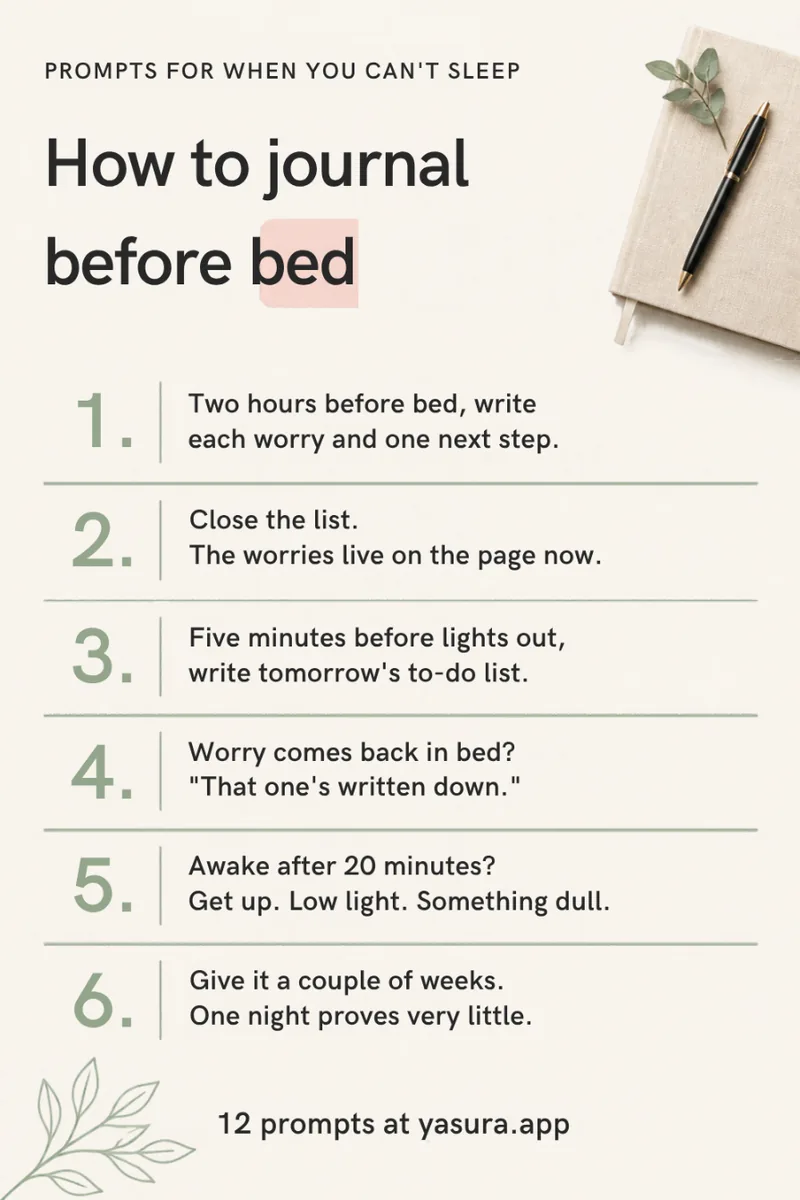
Pick a time, two hours before bed
Spend up to 15 minutes on worries. Write each one, and next to it, the smallest possible next step. “Ask Sam about the deadline” counts. “Fix my life” does not.
Close the list
Fold the page or close the entry. The point is that the worries now live somewhere outside your head, with a plan attached.
Five minutes before lights out, write tomorrow
List what you actually need to do tomorrow and the next few days. Be specific. “Email the landlord about the heater” is better than “house stuff.”
If a worry comes back in bed, point to the list
Tell yourself, “That one’s written down, and it has a next step.” You don’t need to solve it again.
Still awake after 20 minutes? Get up
Go to another room with low light. Read something dull, or write one or two lines from the 2 a.m. prompts below. Go back to bed when you feel sleepy, not just tired.
Give it a couple of weeks
One night proves very little either way. Try the routine for a week or two before you decide whether it works for you.
12 journal prompts for when you can’t sleep
Different nights need different prompts. Pick the group that matches what’s keeping you up.
Early evening: for the worries
- Write down the three things you’re most worried about right now. Next to each one, write one small next step.
- What’s in your control here, and what isn’t? Make two short lists.
- If the thing you’re dreading actually happens, what would you realistically do next?
- What’s one worry you can officially put off until a specific day? Write the day.
Right before bed: for the to-do list in your head
- Tomorrow, the things I actually have to do are… (be specific).
- What am I scared I’ll forget? Write it down so you don’t have to hold it.
- What’s one thing that can wait until later this week, and when will I do it?
- Something that went okay today, even if it was small:
At 2 a.m.: keep it to a few lines
- Right now I feel ___ because ___. (One word for the feeling is enough.)
- The conversation I keep replaying. What I wish I’d said, in one sentence:
- What would I tell a friend who was lying awake over this?
- This can wait until morning because…
If you notice that writing about something is winding you up rather than settling you down, stop. That’s useful information, not a failure. We cover the line between helpful worry writing and spiraling in Does Journaling About Anxiety Help, or Make It Worse?
A note about screens
Here’s an awkward truth for someone who builds a journal app: when you wake up at night, the NHS advises avoiding phone and tablet screens. Bright light and the pull to check messages don’t help you get back to sleep. If you write on your phone at night, turn the brightness all the way down, use a dark theme, keep it to a few lines, and don’t open anything else. Or keep a notebook and pen next to the bed for 2 a.m., and save longer writing for the evening.
Everyone has rough nights. But if you have trouble falling or staying asleep three or more nights a week for three months or longer, that’s how insomnia is commonly defined, and it’s worth talking to a doctor. They can check for causes like sleep apnea, restless legs, or medication side effects, and point you to treatments like cognitive behavioral therapy for insomnia (CBT-I). If what keeps you up at night are thoughts of hurting yourself, please don’t wait for morning: in the US, call or text 988 to reach the 988 Suicide & Crisis Lifeline, any time. If you’re in immediate danger, call 911. A journal is not a substitute for medical care or professional help.
Where Yasura fits
I build Yasura, a journal app, so read this part with that in mind. Yasura is a private place for exactly the kind of writing that happens late at night: the worry list, the thing you can’t say to anyone yet. It works 100% offline, with no account and no cloud, and your journal is encrypted on your device. You can lock it with a PIN, Face ID or fingerprint, and Decoy Mode keeps your entries protected if someone else picks up your phone. There are calm dark themes for evening writing, and you pay once, with no subscription and no ads.
But honestly, for 2 a.m., a paper notebook by the bed might be the better tool. Use whatever helps you get the thoughts out of your head and lets you close the page.
Sources: Baylor University, “Can writing your to-do’s help you to doze?” (2018), on Scullin et al., Journal of Experimental Psychology: General; Baylor Proud, “Trouble falling asleep?” (2018); Psychology Today, “The Connection Between Writing and Sleep” (2018); Carney, “The effects of an evening structured problem-solving procedure in undergraduate college students with insomnia,” LSU (2003); Mooney, Espie & Broomfield, “An experimental assessment of a Pennebaker writing intervention in primary insomnia,” Behavioral Sleep Medicine (2009); Tom’s Guide, on the constructive worry method, with clinical psychologist Michael Gradisar; McCann, “CBT for Insomnia,” University of Washington (2018); Mayo Clinic, “Insomnia: what to do when you can’t sleep” (2018); NHS TALKWORKS, “Practical steps for if you can’t sleep or keep waking up at night”; 988 Suicide & Crisis Lifeline.
Try Yasura
A private place for the worry list and the 2 a.m. thoughts. Works 100% offline, no account, no cloud, encrypted on your device and locked with your PIN or biometrics. One-time purchase unlocks Decoy Mode and the rest of the premium features.