It’s 11:40 p.m. You’ve opened the chat three times without typing anything. You know their schedule better than your own. Somewhere in your camera roll is a photo you can’t delete yet and can’t look at either.
Writing is one of the most common things people try after a breakup, and there is some real research on it. Not all of it says “just pour your heart out.” This article covers what the studies found, a simple way to journal through a breakup without reopening the wound every night, and 20 breakup journal prompts for the different stages of getting over someone.
Why a breakup scrambles more than your feelings
A breakup doesn’t only take away a person. It takes away routines, plans, inside jokes and a version of yourself that existed with them. Psychologists Erica Slotter, Wendi Gardner and Eli Finkel studied this in 2010 in a paper titled “Who Am I Without You?” Across three studies, they found that after a breakup, people’s sense of who they are became less clear, and that this confusion added to their distress, on top of the loss of the partner.
The good news is that a clearer sense of self can be rebuilt. In a 2015 study, Grace Larson and David Sbarra followed people who had gone through a breakup in the past six months. Some only filled in questionnaires at the start and the end. Others repeatedly reflected on the breakup over nine weeks, including privately speaking about it into a voice recorder. The group that reflected more recovered better overall, and the researchers linked that to rebuilding a sense of who they were on their own.
What the research says about writing after a breakup
Writing about the good parts. In a 2009 study in The Journal of Positive Psychology, Gary Lewandowski asked about 100 adults who had broken up in the past three months to write at home for 15 to 30 minutes a day, three days in a row. One group wrote about positive aspects of the breakup, one about negative aspects, and one about something unrelated. The positive group reported more positive feelings, like confidence, relief and optimism, without an increase in negative ones. The effect was strongest when the breakup had been mutual.
When digging deeper backfires. In a 2013 University of Arizona study of 90 recently separated adults, the people who ruminated the most were doing best eight months later if they had written plain accounts of their days, not deep emotional writing about the separation. If you tend to replay things, more emotional digging isn’t automatically better.
Thinking about their flaws. In a small 2018 study, Sandra Langeslag and Michelle Sanchez showed 24 heartbroken people photos of their ex while they used different thinking strategies. Recalling the ex’s negative qualities lowered how in love people felt, but it also made them feel worse in the moment. Reminding yourself what wasn’t working may help you let go, but expect it to sting.
The honest summary: these are small studies, and there’s no single right way to write about a breakup. But they point in a similar direction. Writing that helps you see yourself clearly, notice what you’ve gained, and stay time-limited tends to help more than writing that replays the relationship scene by scene.
How to journal through a breakup without reopening the wound
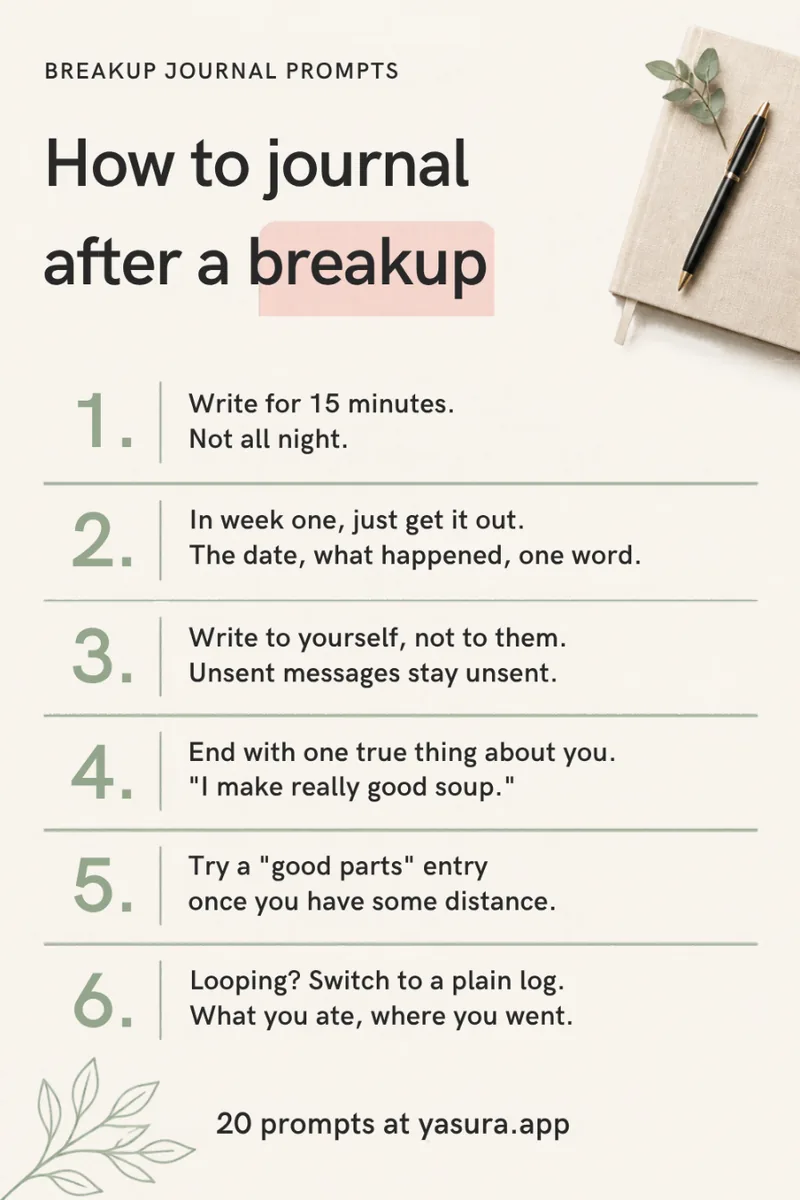
Write for 15 minutes, not all night
The studies used short sessions, 15 to 30 minutes. Set a timer. When it ends, close the page, even mid-sentence.
In the first week, just get it out
The date, what happened, one word for how you feel. That’s enough. You don’t need insight yet.
Write to yourself, not to them
If you catch yourself drafting a message, finish it on the page and don’t send it. Then come back to writing about you. Unsent letters have their own place.
End each entry with one thing that’s true about you
Not about them, not about the relationship. “I’m someone who makes really good soup.” Small counts. This is how the “who am I without you” question starts to answer itself.
Try a “good parts” entry once you have some distance
Not on day one. When you’re ready, write about what’s easier, lighter or more possible now. That’s the kind of writing that helped in the 2009 study.
If you’re looping, switch to a plain log
On days when every entry turns into the same replay, write only what you did today: what you ate, where you went, who you talked to. It still counts as journaling.
20 breakup journal prompts
Pick the group that matches where you are. One or two prompts per session is plenty.
The first few days
- What happened, in plain words, as if I were telling a friend who wasn’t there?
- What’s the hardest moment of the day right now, and what usually happens just before it?
- Who do I want to talk to right now, other than them?
- What do I need tonight to get to tomorrow?
- One thing I did today that took effort, even if it was small:
When you can’t stop thinking about them
- What do I actually miss: them, the routine, the plans, or the feeling of being someone’s person?
- What did I stop doing, saying or wanting while we were together?
- What would I tell a friend who kept replaying this exact relationship?
- Write the full message I want to send them. Don’t send it. What’s the one sentence underneath it?
- What did I already know before it ended?
Finding the good parts, when you’re ready
- What’s one thing that’s easier now?
- What did I learn about what I need in a relationship?
- What can I do now that I couldn’t, or didn’t, before?
- Which friendships or parts of my life have more room now?
- What am I proud of in how I’ve handled this, even on the bad days?
Who I am now
- Finish this sentence five times: “I am someone who…”
- What did I like about myself before this relationship that I want back?
- What’s one small thing I want to try this month, just for me?
- What will I look for next time, and what will I walk away from sooner?
- Write a short letter to myself one year from now.
If you notice that writing about them leaves you more stirred up every time, that’s a signal to switch groups or switch to a plain log for a while. For more on the line between processing and spiraling, see 15 Journal Prompts for Overthinking.
Grief after a breakup is normal and can be intense. But if you’ve felt low most days for weeks, have stopped eating or sleeping properly, or can’t manage work or school, it’s worth talking to a doctor or therapist. If the relationship was controlling or abusive, or you’re worried about your safety now that it’s over, the National Domestic Violence Hotline is free and confidential in the US: call 1-800-799-7233 or visit thehotline.org. If you’re thinking about hurting yourself, call or text 988 to reach the 988 Suicide & Crisis Lifeline, any time. If you’re in immediate danger, call 911. A journal is not a safety plan or a substitute for professional help.
Where Yasura fits
I build Yasura, a journal app, so read this part with that in mind. Breakup writing is the kind you really don’t want anyone else to read, and sometimes that includes the person who still knows your phone’s passcode. Yasura has its own PIN, separate from your phone’s, plus Face ID or fingerprint. It works 100% offline with no account and no cloud, and your journal is encrypted on your device. Decoy Mode keeps your entries protected if someone else picks up your phone. You pay once, with no subscription and no ads.
But honestly, a notebook works for this too. What matters is having one place where you can be completely honest while you figure out who you are on your own.
Sources: ScienceDaily, on Slotter, Gardner & Finkel, “Who Am I Without You? The Influence of Romantic Breakup on the Self-Concept,” Personality and Social Psychology Bulletin (2010); PsyPost, on Larson & Sbarra, Social Psychological and Personality Science (2015); American Psychological Association, “Breakups aren’t all bad,” on Lewandowski, The Journal of Positive Psychology (2009); Florida Tech Psychology Science Minute, “Healing Romance Break-ups”; University of Arizona News on Sbarra et al. (2013); British Psychological Society Research Digest, on Langeslag & Sanchez (2018); National Domestic Violence Hotline; 988 Suicide & Crisis Lifeline.
Try Yasura
A private place for the 11:40 p.m. thoughts and the things you can’t send. Its own PIN, separate from your phone’s. Works 100% offline, no account, no cloud, encrypted on your device and locked with your PIN or biometrics. One-time purchase unlocks Decoy Mode and the rest of the premium features.