You read the message twice. Your jaw is tight, your face is hot, and you’ve already written the perfect reply in your head three times. Part of you wants to send it. Part of you knows you’ll regret it by morning.
Writing is one of the first things people reach for when they’re angry, and it can help. But the research has a twist: how you write matters more than whether you write. A page that replays the fight at full volume can keep you just as angry as shouting would. This article covers what the studies found, a simple way to journal when you’re angry, and 18 journal prompts for anger, sorted by what kind of angry you are.
Why “getting it all out” doesn’t always work
The old idea is that anger builds up like steam and you need to let it out. In 2024, Sophie Kjærvik and Brad Bushman published a meta-analysis in Clinical Psychology Review that pulled together 154 studies with more than 10,000 participants. They found little evidence that venting reduces anger, and some evidence that it can keep it going. Bushman put it bluntly: there is “not a shred of scientific evidence to support catharsis theory.”
What did help were activities that calm the body down: slow breathing, progressive muscle relaxation, mindfulness, slow-flow yoga, and simply taking a timeout. Activities that rev the body up mostly didn’t help, and jogging was the one most likely to increase anger.
That matters for journaling. If your entry is the argument on repeat, with your heart still pounding, you’re probably venting with a pen. The goal is to use the page to slow down, not to wind yourself up.
What the research says about writing when you’re angry
Write it, then throw it away. In a 2024 study in Scientific Reports, Yuta Kanaya and Nobuyuki Kawai at Nagoya University had students write short opinions, then gave them deliberately insulting feedback. Everyone got angrier. The students then wrote about how they felt and what set them off. Across two experiments with 98 participants, those who threw away or shredded the paper afterward came back to their baseline level of anger. Those who kept the paper on their desk calmed down only a little. Kawai said they expected some effect, but anger was “eliminated almost entirely.” It’s one study with students in Japan, on paper, measured in the short term, and the researchers say they still want to test whether digital notes work the same way.
Watch the scene from the outside. In 2012, Dominik Mischkowski, Ethan Kross and Brad Bushman ran two experiments with about 190 students who were provoked on purpose. Afterward, some replayed the moment through their own eyes, and others replayed it as if they were watching from a distance, like a fly on the wall. The distanced group reported less anger and fewer aggressive thoughts, and in the second study they acted less aggressively toward the person who provoked them. Reliving it from the inside didn’t reduce anger.
Watch the words “always” and “never.” The American Psychological Association’s guide to controlling anger recommends replacing exaggerated thoughts with more realistic ones, and specifically warns against words like “never” and “always.” A journal is a good place to catch them, because you can see them on the page.
The honest summary: these are lab studies with mostly students, and none of them followed people for months. But they agree on a direction. Writing that slows your body down, steps back from the scene, and lets the hottest version go seems to help more than writing that keeps the fight alive.
How to journal when you’re angry
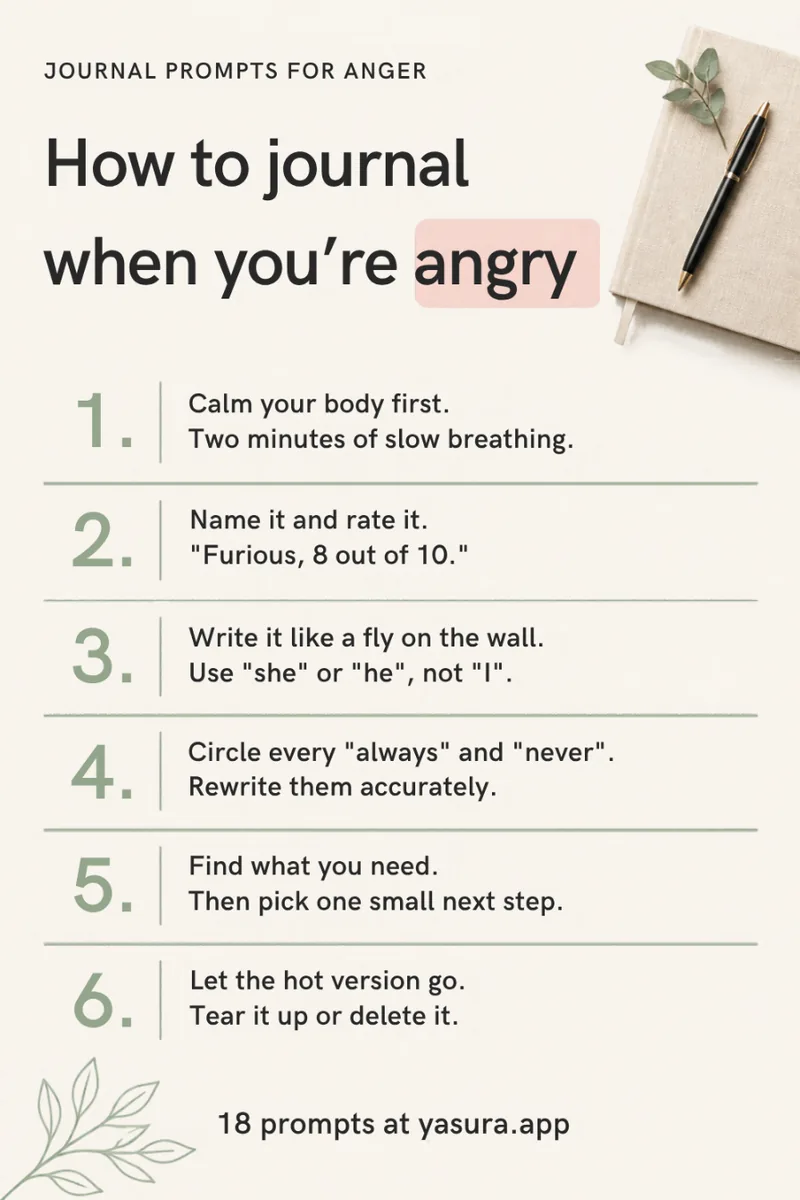
Calm your body before you write
Two minutes of slow breathing from your belly first, which is also what the APA suggests. It feels too simple, but calming the body is what the research actually supports.
Name it and rate it
One word and a number. “Furious, 8 out of 10.” “Hurt, wearing an angry mask, 6.” You’ll rate it again at the end.
Write the scene like a fly on the wall
Use your name or “she” or “he” instead of “I.” Describe what a stranger in the room would have seen and heard. This is the self-distancing that helped in the 2012 studies.
Circle every “always” and “never”
Then rewrite each one so it’s accurate. “He never listens” might become “He didn’t listen tonight, and it’s the third time this month.” Still angry, but now it’s something you can work with.
Find what you need, then pick one next step
Anger usually points at something: respect, fairness, rest, being heard. Write what it is, and one small thing you can do about it. Sometimes the step is “say nothing until tomorrow.”
Let the hot version go
If you wrote a furious first draft, tear it up or delete it. Keep only the calmer reflection, if you want to keep anything. Then rate your anger again.
18 journal prompts for anger
Pick the group that fits. One or two prompts is plenty, especially when you’re still hot.
Right after it happens
- What happened, in plain facts, as if a camera in the corner recorded it?
- Where do I feel this anger in my body right now?
- On a scale of 1 to 10, how angry am I, and what would bring it down by just one point?
- What do I want to do right now, and what will I wish I had done tomorrow morning?
- Write the reply I want to send. Don’t send it. Now write the one I’d send if I were calm.
When you can’t let it go
- What part of this keeps replaying, and what am I hoping will change if I replay it again?
- Which of my thoughts about this use “always” or “never”? What’s the accurate version?
- If a friend told me this story, what would I say to them?
- What did this anger protect me from feeling: hurt, embarrassment, fear, or something else?
- Will this matter in a week? In a year? Which parts will still matter?
When you’re angry at someone you love
- What do I need from them that I haven’t clearly asked for?
- What would I want them to understand, in one sentence, without any blame in it?
- What might be going on for them that I can’t see from here?
- Is this a conversation for tonight, or for a calmer time? What would make it go better?
When you’re angry at yourself
- What exactly did I do, without the insults I’m adding on top?
- What was I trying to do or protect when it happened?
- What would I say to a friend who made the same mistake?
- What’s one thing I can repair, and one thing I need to let go of?
If you notice that every entry turns into the same replay, that’s rumination, not processing. 15 Journal Prompts for Overthinking has more on how to step out of a loop.
Anger is a normal emotion. But if it feels out of control, shows up most days, or is hurting your relationships or work, the American Psychological Association recommends talking to a psychologist or licensed mental health professional, and counseling can help. If you’re worried you might hurt someone, step away and get somewhere safe first. If you or someone else is in immediate danger, call 911. If you’re in emotional distress, you can call or text 988 in the US to reach the 988 Suicide & Crisis Lifeline, any time. A journal is not a safety plan or a substitute for professional help.
Where Yasura fits
I build Yasura, a journal app, so read this part with that in mind. First, an honest note: the Nagoya study used paper, and keeping the page was exactly what didn’t help. So for the hot first draft, a scrap of paper you can tear up is a great tool, and deleting the entry works too if you write it in an app.
Where a private journal helps is the calmer part: the “what did I actually need” entry you might want to read again in a month. Anger writing is usually about real people, so it matters that nobody else can open it. Yasura has its own PIN, separate from your phone’s, plus Face ID or fingerprint. It works 100% offline with no account and no cloud, and your journal is encrypted on your device. Decoy Mode keeps your entries protected if someone else picks up your phone. You pay once, with no subscription and no ads.
But a notebook works for this too. What matters is having somewhere to slow down before you hit send.
Sources: ScienceAlert, on Kjærvik & Bushman, Clinical Psychology Review (2024); Nagoya University, on Kanaya & Kawai, Scientific Reports (2024); ScienceAlert, on the same Nagoya study; Ohio State University News, on Mischkowski, Kross & Bushman, Journal of Experimental Social Psychology (2012); American Psychological Association, “Control anger before it controls you”; SAMHSA, 988 Lifeline fact sheet.
Try Yasura
A private place to slow down before you hit send. Its own PIN, separate from your phone’s. Works 100% offline, no account, no cloud, encrypted on your device and locked with your PIN or biometrics. One-time purchase unlocks Decoy Mode and the rest of the premium features.